
Cybersecurity teams today are dealing with more alerts, more devices, and more security data than ever before. As a result, many organizations are exploring managed security services to help fill skills and resource gaps. One question that frequently comes up during that process is: what is SOC as a Service? While the concept is becoming more common, there is still confusion around how it differs from a traditional Security Operations Center (SOC), a Security Information and Event Management (SIEM) platform, and Managed Detection and Response (MDR) services. Understanding these differences helps organizations better understand how modern security operations work.
What Is SOC as a Service?
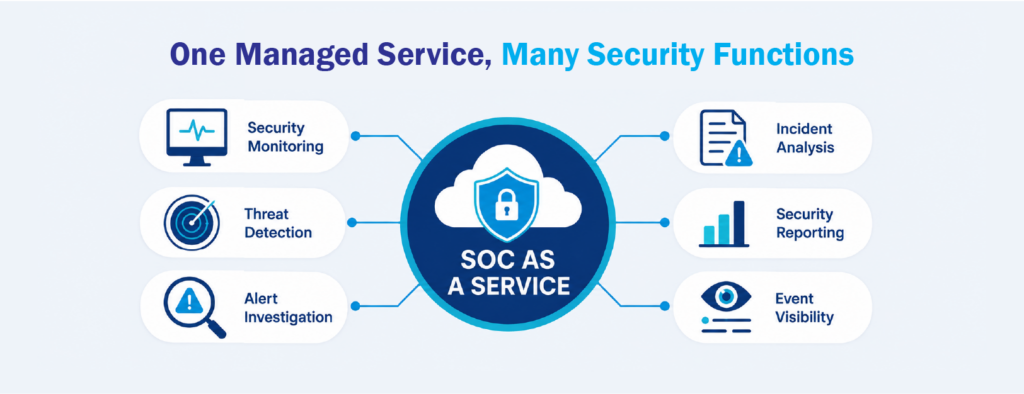
At its core, SOC as a Service (SOCaaS) is a managed cybersecurity service that provides organizations with access to Security Operations Center capabilities without requiring them to build and operate a full in-house SOC.
Traditionally, a SOC consists of security analysts, threat detection tools, monitoring platforms, and incident response processes working together to identify and address cyber threats. Building and maintaining such a capability can be expensive, particularly for organizations that need continuous monitoring but do not have the budget or personnel to operate a 24/7 security team.
SOC as a Service addresses that challenge by delivering many of the same functions through an external service model. Organizations continue operating their business while security specialists monitor alerts, investigate suspicious activity, and help identify potential threats.
A SOC as a Service offering typically includes:
- Security monitoring
- Threat detection
- Alert investigation
- Incident analysis
- Security reporting
- Security event visibility
The exact scope varies between providers, but the overall goal remains the same: helping organizations improve their ability to detect and respond to cybersecurity threats.
Why Organizations Are Moving Toward SOC as a Service
Security threats do not follow business hours. Attackers often target organizations during weekends, holidays, or overnight periods when internal teams may be unavailable.
Many IT departments are already responsible for infrastructure, cloud services, user support, compliance requirements, and system maintenance. Adding around-the-clock security monitoring can be difficult without expanding headcount significantly.
SOC as a Service allows organizations to supplement internal resources with dedicated security expertise. Instead of building an entire operations center from scratch, businesses gain access to security analysts and monitoring capabilities through a subscription-based model.
This approach has become increasingly popular as organizations face:
- Growing ransomware activity
- More sophisticated phishing attacks
- Expanding cloud environments
- Hybrid work environments
- Increasing regulatory requirements
Industry guidance from organizations such as CISA and the National Institute of Standards and Technology (NIST) consistently emphasizes continuous monitoring and timely threat detection as important components of a strong cybersecurity program.
SOC as a Service vs Traditional SOC
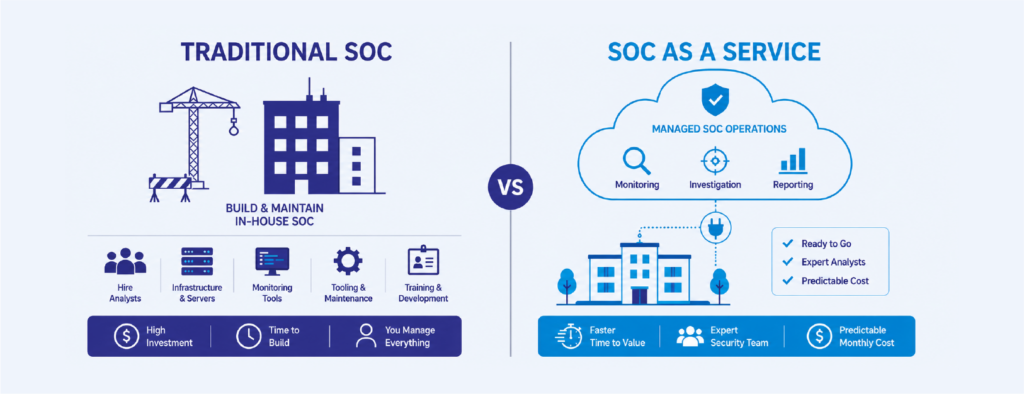
One of the most common sources of confusion comes from the relationship between SOC as a Service and a traditional Security Operations Center.
A traditional SOC is typically built and operated internally. The organization purchases and manages the technology stack, hires analysts, develops security procedures, and handles day-to-day operations.
This approach provides direct control over security operations, but it can require substantial investment. Organizations often need multiple analysts, specialized tooling, ongoing training, and enough personnel to maintain coverage across different shifts.
SOC as a Service follows a different model.
Rather than creating an internal operations center, organizations use an external provider that supplies the people, processes, and technology required for monitoring and threat detection. This allows businesses to gain SOC capabilities without building the entire operation themselves.
That does not mean one approach is universally better than the other. Large enterprises with extensive security requirements may maintain their own SOC, while many mid-sized organizations find that a managed model aligns better with their staffing and budget realities.
SOC as a Service vs SIEM
Another common misconception is that SOC as a Service and SIEM are the same thing.
In reality, they solve different problems.
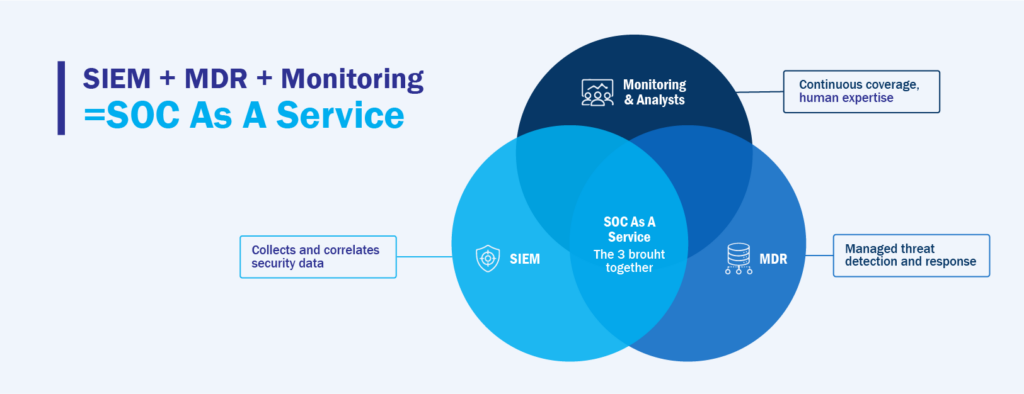
A SIEM (Security Information and Event Management) platform is a technology solution. Its primary role is collecting, correlating, and analyzing security data from various systems such as servers, endpoints, firewalls, applications, and cloud services.
A SIEM can help identify suspicious activity by processing large volumes of log and event data. However, a SIEM on its own does not necessarily provide people to investigate alerts or make security decisions.
SOC as a Service, on the other hand, is a service that often incorporates SIEM technology as part of its broader operation.
A helpful way to think about it is this:
- A SIEM is a tool.
- A SOC as a Service is an operational security function that may use that tool.
Organizations sometimes deploy a SIEM and discover that generating alerts is only part of the challenge. Someone still needs to review, investigate, and determine whether those alerts represent actual threats. That is where security analysts and operational expertise become important.
SOC as a Service vs MDR
SOC as a Service and Managed Detection and Response (MDR) are often mentioned together because they share several similarities.
Both services focus on improving threat detection and helping organizations respond to cyber incidents. Both typically involve security specialists monitoring environments and investigating suspicious activity.
Where differences often emerge is in scope.
MDR services frequently focus heavily on endpoint detection, advanced threat hunting, and response-oriented activities. Many MDR providers build their offering around Endpoint Detection and Response (EDR) technologies and use those capabilities to identify threats within endpoints and workloads.
SOC as a Service generally provides a broader operational view by aggregating information from multiple sources, including:
- Firewalls
- Network devices
- Endpoints
- Cloud environments
- Identity platforms
- Security tools
The exact boundaries depend on the provider, and the market continues to evolve. Some services blend SOC and MDR capabilities together, which is one reason the terminology can sometimes overlap.
For organizations evaluating different security monitoring options, understanding the coverage areas and operational focus of each service is often more useful than focusing solely on labels.
How Security Monitoring Fits Into the Picture
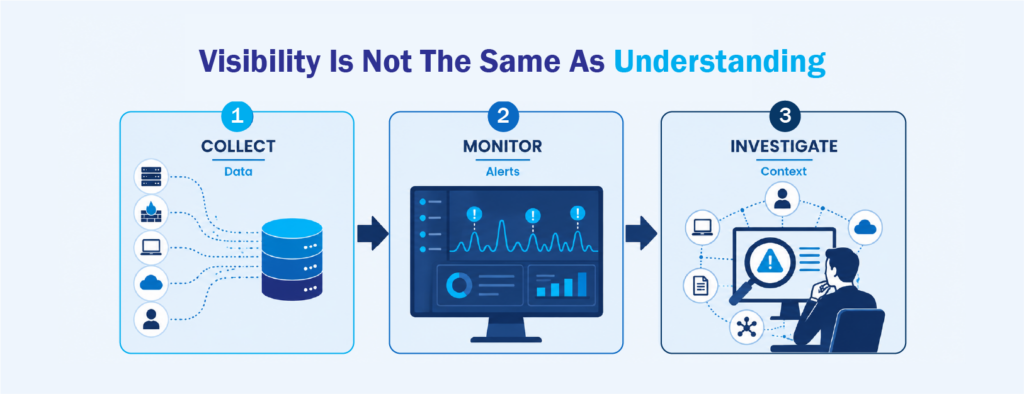
Security monitoring is often discussed alongside SOC services, but it is important to understand that monitoring itself is not the entire solution.
Monitoring involves collecting and observing security events across an organization’s environment. It creates visibility into what is happening across systems, users, applications, and networks.
However, visibility alone does not reduce risk.
When suspicious activity appears, someone must review the information, determine whether it represents malicious behavior, assess potential impact, and decide what actions should be taken next.
That combination of technology and human analysis is one of the reasons SOC operations remain important. Monitoring helps surface potential issues, while analysts provide investigation and operational context.
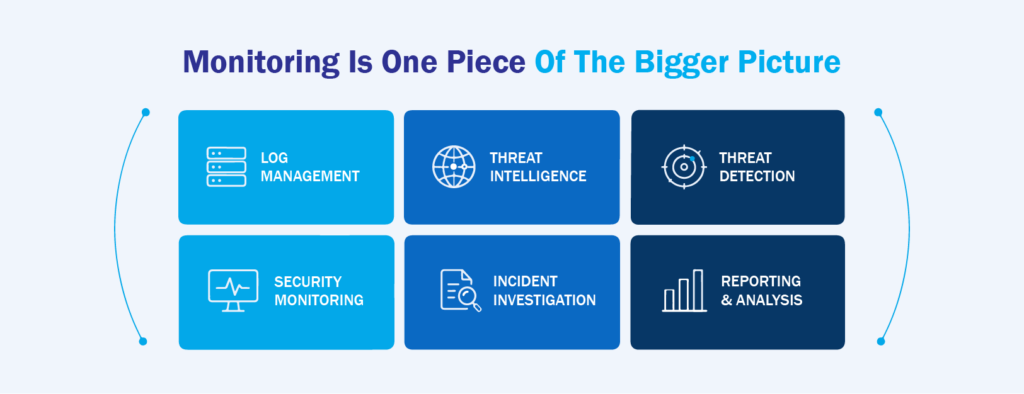
Modern SOC services often bring together:
- Log management
- Security monitoring
- Threat intelligence
- Threat detection
- Incident investigation
- Reporting and analysis
These components work together to provide a more complete security picture.
How SOC as a Service Fits into Security Operations
After exploring how SOC as a Service works, it becomes easier to understand where it fits within a broader cybersecurity program.
Many organizations already use security tools such as firewalls, endpoint protection platforms, email security solutions, and SIEM systems. These technologies generate valuable data, but they do not always provide the context needed to determine whether an alert represents a genuine threat. SOC as a Service helps bridge that gap by combining technology, security expertise, and continuous monitoring to provide clearer insight into potential security incidents.
Rather than replacing existing security investments, SOC services typically work alongside them. In many environments, SIEM platforms, MDR services, and SOC operations complement one another, helping organizations improve visibility, threat detection, and overall security monitoring.
What Is SOC as a Service? Key Takeaways
SOC as a Service is best understood as a managed approach to security operations. Rather than functioning as a standalone technology platform, it combines monitoring tools, security expertise, and ongoing threat analysis to help organizations identify and investigate suspicious activity.
It is also important to remember that SOC as a Service, MDR, SIEM platforms, and traditional SOCs are not interchangeable terms. Each serves a different purpose within a cybersecurity strategy, and understanding those distinctions helps provide a clearer picture of how modern security operations work.
For readers interested in seeing how these concepts are applied in practice, CT Link’s Managed Security Operations Center (MSOC) services offer additional insight into how continuous monitoring, threat detection, and security event investigation can be delivered through a managed security model.
Still a bit confused on what is soc as a service? Set a consultation with us today through our email marketing@ctlink.com.ph!