
Most security teams already agree with the idea behind CTEM. Short for Continuous Threat Exposure Management, it is a structured way to keep finding and fixing the security gaps that put your business most at risk, on a continuous basis rather than once in a while.
Teams know reactive vulnerability scanning is not enough, and they know attackers look for weak spots long before anyone inside the network notices. The hard part is not buying into the concept. It is finding the people, hours, and consistency to actually run it. That gap is exactly why more organizations lean on a Managed ERM (External Risk Management) service to carry the continuous work of exposure management instead of building the whole thing in-house.
CTEM was introduced by Gartner in 2022 as a five-stage framework covering scoping, discovery, prioritization, validation, and mobilization. It is a program, not a product you install and forget.
That is where reality bites. Industry research suggests that while roughly 87% of security leaders recognize CTEM’s importance, only around 16% have actually operationalized it. The strategy is widely understood. The staffing and daily execution are where things stall.
That is the space a Managed ERM service is built for. Rather than asking your team to stand up every stage of a CTEM program, the service operates the platform on your behalf, configuring, monitoring, investigating, and escalating, so your people receive prioritized intelligence instead of another firehose of raw data. Below are five practical reasons decision-makers find this route worth a look.
Why Most CTEM Programs Stall on Execution
Before getting to the reasons, it helps to name the real problem. CTEM is a continuous cycle, not a quarterly project. Each stage feeds the next, and the whole thing only works if someone keeps the loop turning week after week. When a small team tries to run all five stages alongside their day jobs, the cycle tends to break at the least glamorous stages, usually validation and mobilization.
Gartner’s own guidance points to the external attack surface as a sensible starting point for CTEM, partly because it has a clearer boundary and mature tooling. A Managed ERM service leans directly into that starting point. It focuses first on what an attacker can see from the outside, then keeps that visibility current, which is far more sustainable than trying to boil the ocean internally on day one.
5 Reasons a Managed ERM Service Makes CTEM Easier
When leaders compare building a program themselves against handing the heavy lifting to a service, the same handful of tradeoffs come up again and again. Here are the five that matter most.
The hidden staffing cost of running it around the clock
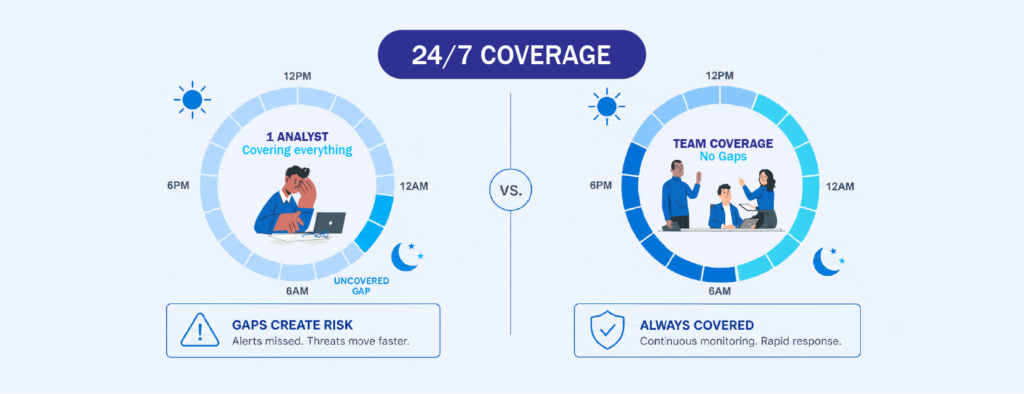
Attackers do not keep office hours, and neither can a serious CTEM program. Running discovery, monitoring dark web activity, and triaging alerts is a continuous job, not a task you schedule for Tuesday afternoons. Staffing that in-house means hiring analysts who can cover nights and weekends, which is expensive and hard in a market where skilled security people are scarce.
A Managed ERM service spreads that cost across a shared team of analysts who are already watching. Instead of paying to build a 24/7 rotation from scratch, you get continuous coverage as part of the service. For most mid-sized organizations, that math alone makes the managed route easier to justify.
You get prioritized intelligence, not raw findings
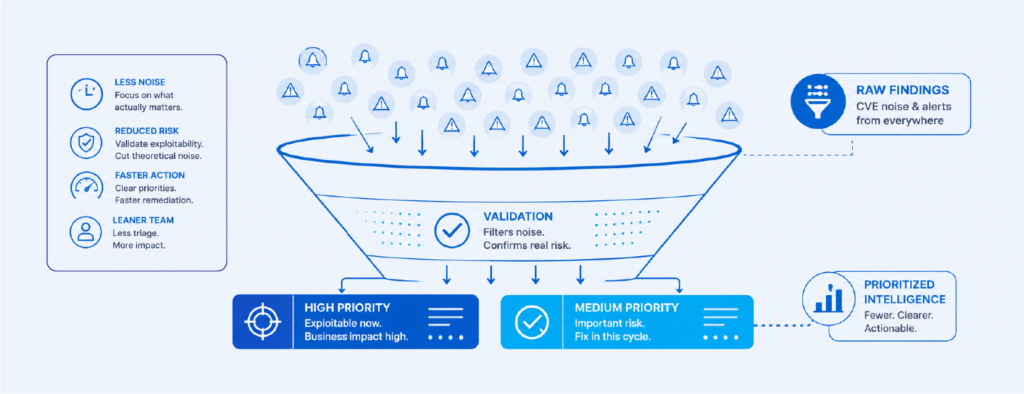
One of the biggest frustrations with do-it-yourself exposure management is volume. Scanners produce long lists of CVEs, and most of them turn out to be theoretical in your specific environment. A CVE, short for Common Vulnerabilities and Exposures, is simply a publicly listed security flaw in software or hardware, each given a unique ID so everyone refers to the same issue. The catch is that a flaw being on that list does not mean it can actually be exploited in your setup. Without someone to sort real risk from noise, teams end up chasing low-value items while genuine exposures sit untouched.
The validation stage of CTEM is what solves this. A Managed ERM service uses active exposure validation to test whether a discovered weakness is actually exploitable in your environment, not just present in a database somewhere. That testing separates real, actionable risks from the theoretical ones and dramatically reduces the noise your team has to wade through. It also catches issues that fall outside traditional CVE lists, such as misconfigurations, open ports, exposed admin interfaces, and insecure cloud storage. The result is a short, ranked list of things that matter, with recommended next steps attached.
Broader visibility across your external attack surface
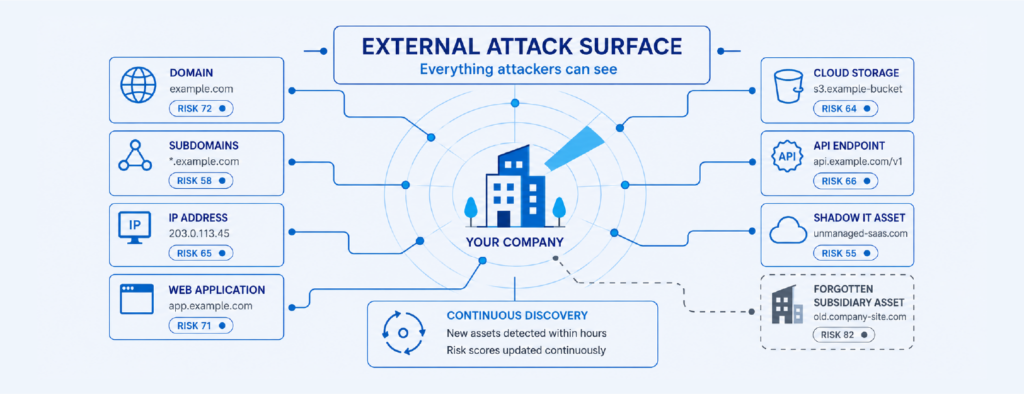
Running external attack surface management (EASM) well means continuously discovering every internet-facing asset tied to your organization. That includes domains, subdomains, IP addresses, cloud storage, APIs, web applications, and the shadow IT that no one documented. It often includes forgotten assets from subsidiaries or past acquisitions, which are exactly the kind of thing attackers love to find first.
Doing this properly in-house requires tooling, tuning, and constant attention, because new assets appear all the time. A Managed ERM service runs that discovery continuously, catalogs each asset, checks it for weaknesses, and assigns a risk score to guide remediation. Newly exposed assets get picked up within hours of appearing online, which is very hard to match with a small internal team juggling other priorities.
Coverage for threats CVEs never show you
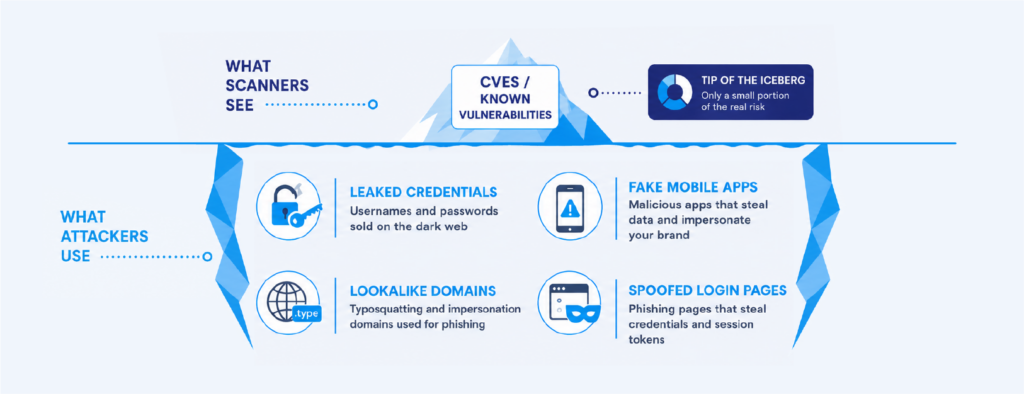
A lot of real-world risk lives outside your network entirely. Leaked credentials get traded on dark web markets, attackers register lookalike domains to phish your staff and customers, and criminals set up fake apps and spoofed login pages using your brand. None of that shows up in a vulnerability scan of your own systems.
A Managed ERM service puts analysts on this constantly, watching criminal forums, marketplaces, paste sites, and messaging channels for mentions of your organization, your executives, or your credentials. When something credible surfaces, such as your logins appearing in a breach dump, they triage it, add context, and send a prioritized alert with recommended actions. For brand impersonation, they can start a takedown process with registrars and hosting providers to get fraudulent assets removed. Building and staffing that kind of external monitoring in-house is realistically out of reach for most teams.
Intelligence that connects into your existing SOC and SIEM
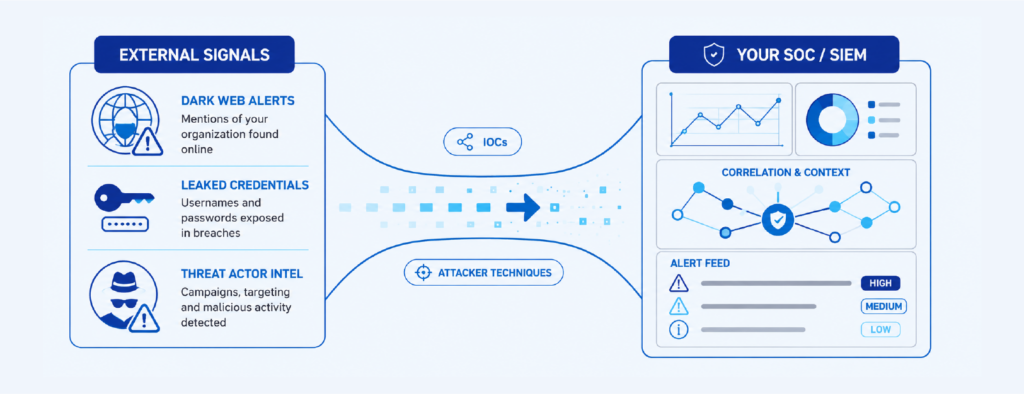
CTEM works best when external insight and internal detection talk to each other. A finding about leaked credentials means far more when your SOC can immediately look for signs those credentials are already being used inside your environment.
A Managed ERM service is built to feed that loop. Threat intelligence, indicators of compromise, and attacker techniques mapped to the MITRE ATT&CK framework flow into your SIEM for correlation with internal telemetry. That turns external risk data into something your existing tools and team can act on right away, rather than another disconnected dashboard nobody checks.
Signs a Managed Approach Might Fit Your Team
You do not need every one of these to be true, but a few of them together usually point toward a managed model. If your analysts spend more time triaging scanner output than fixing anything, if nobody is watching after hours, or if you have no real visibility into what attackers see from the outside, the in-house approach is likely costing you more than it saves.
Most leaders already believe in CTEM as a framework, and the argument for it is settled. The real question is not whether to do exposure management, but how to run it consistently without burning out a small team. This is where a Managed ERM service quietly does its best work, delivering the continuous CTEM cycle as an outcome rather than another set of tasks to staff.
Where This Leaves You
CTEM gives you a proven structure for reducing the exposures that actually matter, and external risk is the smartest place to start. The reasons teams turn to a Managed ERM service come down to cost, coverage, and consistency. You get around-the-clock monitoring, validated priorities instead of noise, wide visibility across your attack surface, coverage for threats that live beyond CVEs, and intelligence that plugs into the tools you already run. If running the full CTEM cycle in-house feels like more than your team can carry right now, a Managed ERM service is a practical way to get the outcome without the overhead. It is worth a conversation when you are ready to explore it.
Interested in learning more about CTEM and managed ERM? Contact us at marketing@ctlink.com.ph to set a consultation with us today!