
Many organizations approach Human Risk Management through security awareness training. Employees attend courses, take tests, and complete phishing simulations. On paper, everything looks fine.
Yet human driven breaches continue to rise. People still click the wrong links. Credentials still get stolen. Sensitive data still gets exposed.
The problem is not a lack of effort or education. The problem is visibility.
Most security teams cannot clearly see how users behave across email, identity, and data systems. Without that insight, risk develops quietly, even in well trained organizations.
Human Risk Management works best when it focuses on visibility rather than relying only on training. When behavior is visible and connected, security teams can reduce risk earlier, support employees more effectively, and prevent small mistakes from turning into serious incidents.
The Four Gaps That Cause Human Risk Management to Fail
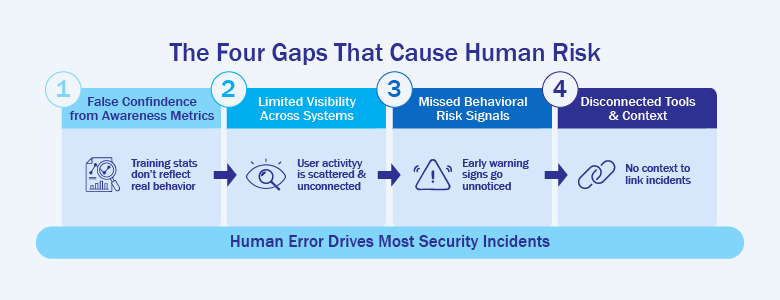
When organizations rely too heavily on training alone, Human Risk Management tends to fail in four predictable ways.
First, awareness metrics often give a false sense of safety. Completion rates look good, but they don’t reflect how people behave during real work.
Second, security teams lack visibility into everyday user activity. Risk develops quietly when email, identity, and data signals are not connected.
Third, meaningful behavioral signals are missed. Small, repeated actions often point to growing risk long before an incident occurs.
Finally, disconnected tools make it difficult to understand how human driven incidents actually unfold, leaving teams reacting instead of preventing.
Why Traditional Awareness Metrics Fall Short
The first gap appears in how organizations measure success.
Security awareness training plays an important role in building a security conscious culture. It helps employees recognize common threats and understand expectations. Problems arise when awareness metrics are treated as proof that risk is under control.
Completion rates and test scores show participation, not real world behavior. People behave very differently under stress, urgency, or fatigue. Even well trained employees will occasionally make the wrong call.
Training can reduce mistakes, but it cannot eliminate them. When organizations rely too heavily on awareness metrics, they risk assuming safety where exposure still exists.
Human Risk Management needs to look beyond what users know and focus on how users behave during everyday work.
What Security Teams Cannot See Today
A second gap emerges from limited visibility across systems.
Security teams often work with fragmented visibility. Email security tools, identity systems, endpoints, and data platforms all capture pieces of user behavior, but rarely in one clear view.
This creates blind spots. A suspicious email, an unusual login, or abnormal data access might not look alarming on its own. When those signals are not connected, early warning signs are easy to miss.
Without context, teams are forced to react after an incident happens instead of preventing it earlier. Effective Human Risk Management depends on seeing user behavior across systems, not in isolation.
Behavioral Signals That Actually Indicate Risk
The third gap involves missed behavioral signals.
Real risk shows up through behavior patterns, not training reports. Small actions, repeated over time, often point to growing exposure long before an incident occurs.
Common examples include repeated interaction with suspicious emails, unusual login behavior, accessing data outside a normal role, or attempts to bypass security controls. These actions are often unintentional, but they still increase risk.
Behavioral analytics helps teams focus on trends instead of single mistakes. By identifying patterns early, security teams can intervene before minor issues escalate into damaging incidents.
Correlating Email, Identity, and Data Activity
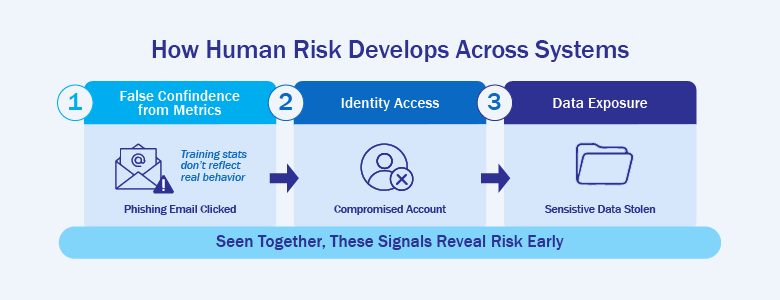
The fourth gap shows up when tools operate in silos.
Human driven incidents rarely stay within one system. A phishing email can lead to stolen credentials, which then enable unauthorized access and data exposure.
Seeing these events together provides clarity that individual alerts cannot. Correlation helps teams separate real risk from background noise and act with more confidence.
Human Risk Management becomes far more effective when email, identity, and data signals are viewed as parts of the same story rather than separate problems.
How Platforms Like Mimecast Surface Risky Patterns
Human Risk Management platforms are designed to close these visibility gaps.
Mimecast supports this by helping organizations gain clearer insight into user behavior and emerging risk patterns across communication channels. Risk scoring allows security teams to quickly identify users who may need additional support based on observed behavior.
By bringing together signals from email activity and related user behavior, Mimecast helps security teams identify patterns that would otherwise remain hidden. This allows teams to focus attention where human risk is most likely to emerge, rather than relying on broad or generic responses.
Measuring Progress Without Blaming Users
Effective Human Risk Management focuses on outcomes, not punishment.
The goal is to reduce incidents, improve detection time, and support employees before mistakes escalate. Tracking behavior trends rather than individual errors helps create a healthier security culture.
Visibility allows organizations to design safeguards that absorb mistakes instead of assigning blame. This encourages earlier reporting, faster response, and better long term risk reduction.
Where Visibility Has the Greatest Impact
Human Risk Management tends to fail when organizations rely on training alone.
Awareness metrics can look reassuring, but they don’t reflect how people behave under real world pressure. Visibility gaps across systems allow risk to develop quietly. Behavioral patterns go unnoticed until it’s too late. Disconnected tools make incidents harder to understand and stop.
Shifting focus to visibility changes this dynamic.
When organizations can see how users interact with email, identity, and data systems day to day, they can reduce risk earlier and respond more effectively. Platforms like Mimecast support this approach by helping security teams connect behavior, context, and response, making Human Risk Management more practical and far less dependent on perfect human behavior.
Interested in learning more about Human Risk Management and Mimecast solutions? Contact us at marketing@ctlink.com.ph to set up a meeting with us today!