
Most organizations focus their security budgets on what is inside the network. Firewalls, endpoint protection, email filters. These are important, but they only cover half the picture. Exposure risk management flips the perspective. Instead of looking outward from your network, it looks inward from the attacker’s point of view, identifying what your organization is already showing the outside world.
For Philippine businesses, this shift in perspective is overdue. In Q1 2025 alone, over 1.2 million compromised credentials tied to Philippine organizations were recorded, many linked to enterprise email, VPN, and single sign-on (SSO) systems. Meanwhile, phishing websites targeting the Philippines surged 423% from 2024 to 2025, jumping from 731 to 3,824 detected sites. These are not abstract numbers. They represent real entry points that attackers are actively scanning and exploiting.
Why External Threats Are Growing in the Philippines
The Philippines is digitizing fast. More businesses are moving services online, adopting cloud platforms, and expanding their digital presence. But security maturity is not keeping up with that pace.
According to Check Point Research’s Philippine Threat Landscape Report 2025, cybercrime in the country is increasingly defined by automation, scale, and identity-based deception rather than highly technical exploits. Attackers are leveraging social engineering, spoofed websites, and stolen credentials to get in, often without needing to bypass any firewall at all.
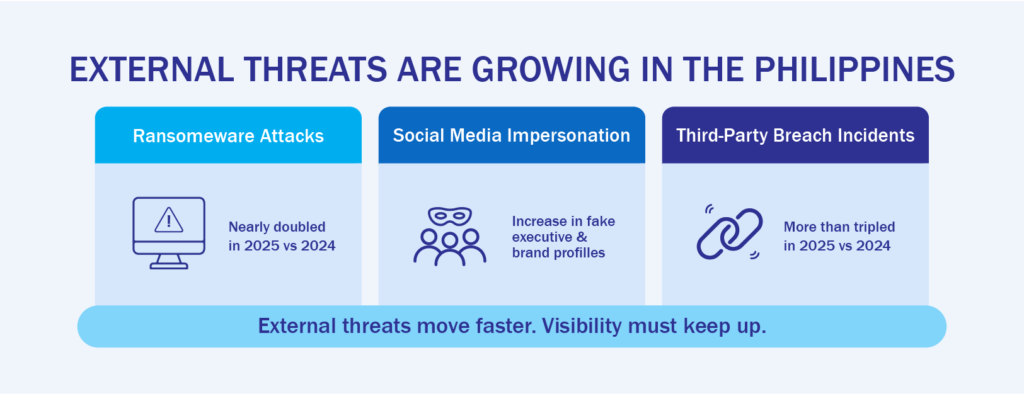
The numbers tell a clear story. Check Point’s monitoring of Philippine organizations recorded nearly double the ransomware attacks in 2025 compared to 2024, with the Qilin ransomware group emerging as the most aggressive actor using double extortion tactics. Social media impersonation climbed 37%, with fake executive and brand profiles jumping from 940 to 1,291 detected cases. Third-party breach incidents more than tripled, increasing from 8 to 29 cases. And all of this happened while many organizations still relied on periodic vulnerability scans as their primary risk management approach.
What Exposure Risk Management Actually Covers
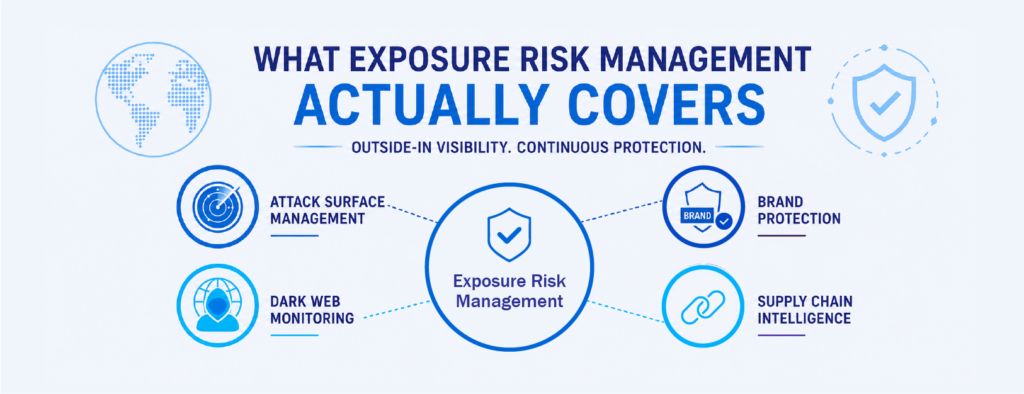
Exposure risk management is the practice of continuously identifying, monitoring, and reducing the external risks that your organization faces from the outside in. It goes beyond traditional vulnerability scanning by focusing on what is visible and exploitable to threat actors right now, not just what is technically misconfigured inside your environment.
At its core, exposure risk management combines several disciplines: attack surface management (ASM) to discover internet-facing assets, dark web monitoring to detect leaked credentials and data, brand protection to catch impersonation campaigns, and supply chain intelligence to assess third-party risks. Together, these areas give security teams a complete view of their organization’s external exposure. You may also see this referred to as External Risk Management (ERM) in some vendor and industry contexts, but the goal is the same: visibility into what attackers can see and use against you before they strike.
This approach aligns with the Continuous Threat Exposure Management (CTEM) framework, which emphasizes ongoing visibility and prioritization over one-time assessments. While CTEM provides the strategic framework, exposure risk management delivers the operational layer that makes it actionable.
6 External Risks That Exposure Risk Management Addresses
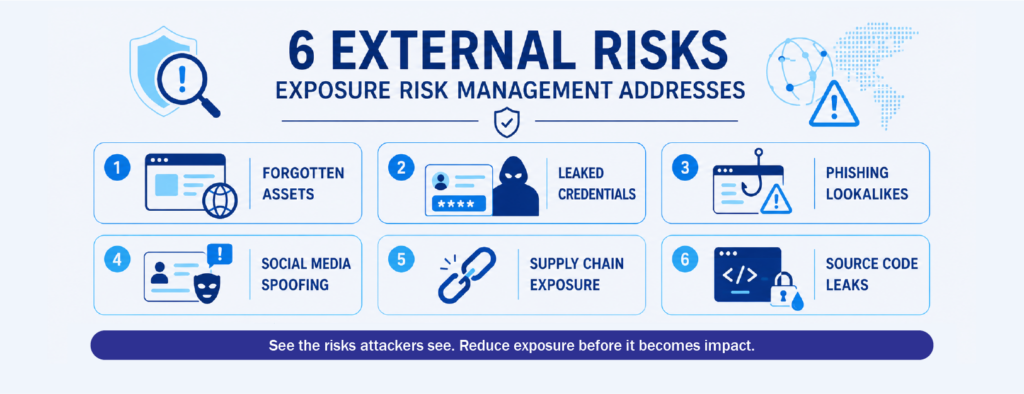
Exposed and Forgotten Internet-Facing Assets
Every organization has a digital footprint, and it is almost always larger than what IT teams officially track. Forgotten subdomains, test environments left online, unsecured application programming interface (API) endpoints, and legacy systems that were never decommissioned all create entry points. Attack surface management, a core component of exposure risk management, continuously discovers these assets the same way an attacker would: by scanning from the outside. In 2026, Unit 42 researchers found that 87% of security incidents spanned at least two attack surfaces, with identity implicated in nearly 90% of cases. If your team does not know an asset exists, it cannot protect it.
Compromised Credentials on the Dark Web
Credential theft is one of the fastest-growing threats facing Philippine organizations. Viettel Threat Intelligence reported 1.2 million compromised credentials in the Philippines during Q1 2025 alone, many tied to enterprise email, VPN, and SSO systems. By Q3 2025, data breaches in the Philippines had surged 49%, exposing over 52 million credentials in just three months. Dark web monitoring tracks underground forums, marketplaces, paste bins, Telegram channels, and ransomware leak sites to identify when your organization’s credentials appear. Early detection means your team can force password resets and close access before attackers use those credentials to move laterally through your systems.
Brand Impersonation and Phishing Lookalikes
Attackers frequently create fake websites and domains that mimic legitimate Philippine businesses, particularly banks, e-wallet providers, and telecom companies. These phishing lookalikes are designed to trick customers and employees into entering credentials or personal information. Kaspersky’s 2024 Financial Threat Report recorded 38,370 phishing attempts targeting financial institutions in the Philippines, making it one of the most targeted countries in Southeast Asia. Exposure risk management tools continuously scan for newly registered domains, lookalike URLs, and spoofed landing pages that use your brand identity. When detected, these can be taken down before they reach your customers.
Social Media Spoofing
Beyond websites, attackers are also creating fake social media profiles that impersonate executives, brands, and official company pages. Check Point Research reported a 37% year-on-year increase in social media impersonation in the Philippines, with cases rising from 940 to 1,291 in 2025. These fake profiles are used to promote fraudulent investment schemes, distribute malware links, and harvest personal information. Financial institutions are the primary targets, but healthcare, telecom, and government organizations are also affected. Monitoring social platforms for unauthorized use of your brand and executive names is a key part of managing external exposure.
Supply Chain and Third-Party Exposure
Your organization’s security posture is only as strong as the weakest link in your supply chain. Philippine businesses are increasingly reliant on third-party vendors, cloud service providers, and software platforms, and attackers know this. Check Point’s 2025 report found that third-party breach incidents in the Philippines rose from 8 to 29 cases in a single year. Exposure risk management includes supply chain intelligence, which continuously monitors your vendors’ cyber hygiene, breach history, and dark web activity. This helps your team identify risks from partners before those risks become your own.
Source Code and Sensitive Data Leaks
When proprietary source code, internal documents, or sensitive configurations are leaked online, they give attackers a detailed map of your systems. These leaks often surface on code repositories, paste sites, or dark web forums. For Philippine organizations, this risk has grown significantly, with source code leak detections more than doubling between 2024 and 2025. Exposure risk management platforms monitor for these leaks and alert security teams so they can assess the impact and respond before the exposed information is weaponized.
How Exposure Risk Management Connects to a CTEM Strategy
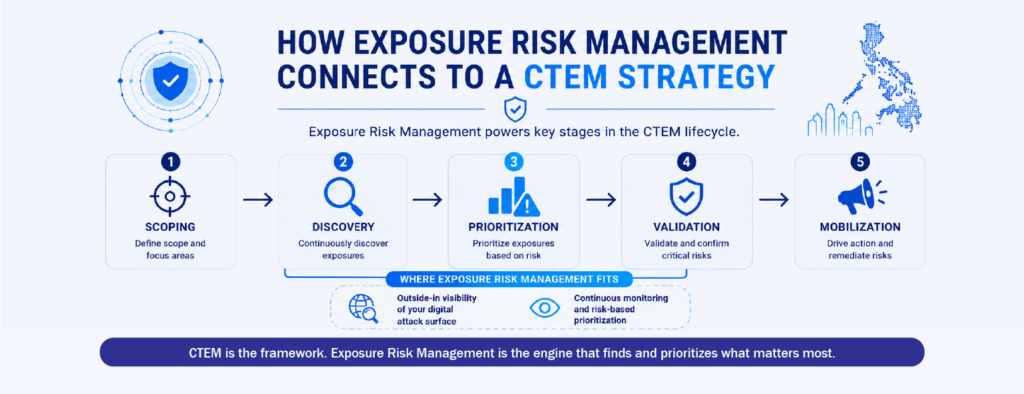
If your organization is already exploring Continuous Threat Exposure Management (CTEM), exposure risk management fits directly into that framework. CTEM outlines a continuous cycle of scoping, discovery, prioritization, validation, and mobilization. Exposure risk management operationalizes the discovery and prioritization stages by providing real-time visibility into what is exposed and what needs attention first.
Gartner has projected that organizations adopting CTEM with proper mobilization will see 50% fewer successful attacks by 2028. The key is connecting the intelligence you gather from external monitoring to the actions your team takes internally. Without that connection, exposure data becomes more noise in an already overloaded security operation.
For a deeper look at how the CTEM framework works and why it matters for Philippine organizations, see our guide on /continuous-threat-exposure-management-basics/.
Reducing Your External Exposure: Where to Start
Getting started with exposure risk management does not require replacing your existing security stack. It begins with visibility: understanding what your organization looks like from the outside.
A practical starting point is to map your external-facing assets. This includes domains, subdomains, IP addresses, cloud services, and any publicly accessible applications. From there, layering in dark web monitoring and brand protection helps you catch threats that traditional perimeter tools miss entirely.
For organizations that want a managed approach, working with a partner that offers External Risk Management (ERM) services can accelerate the process. These services handle the heavy lifting of continuous monitoring, alert triage, and threat takedowns, allowing your internal team to focus on remediation and response. Check Point’s Exposure Management platform, for example, consolidates attack surface management, dark web monitoring, brand protection, and supply chain intelligence into a single solution, and integrates with over 75 existing security controls across major vendors.
The external threat landscape in the Philippines is not slowing down. Credential theft, brand impersonation, and supply chain exposure are all accelerating. The organizations that manage these risks proactively will be better positioned to protect their customers, their data, and their reputation.
To learn more about exposure risk management and Check Point’s other solutions, you may contact us at marketing@ctlink.com.ph to set a consultation with us today!